


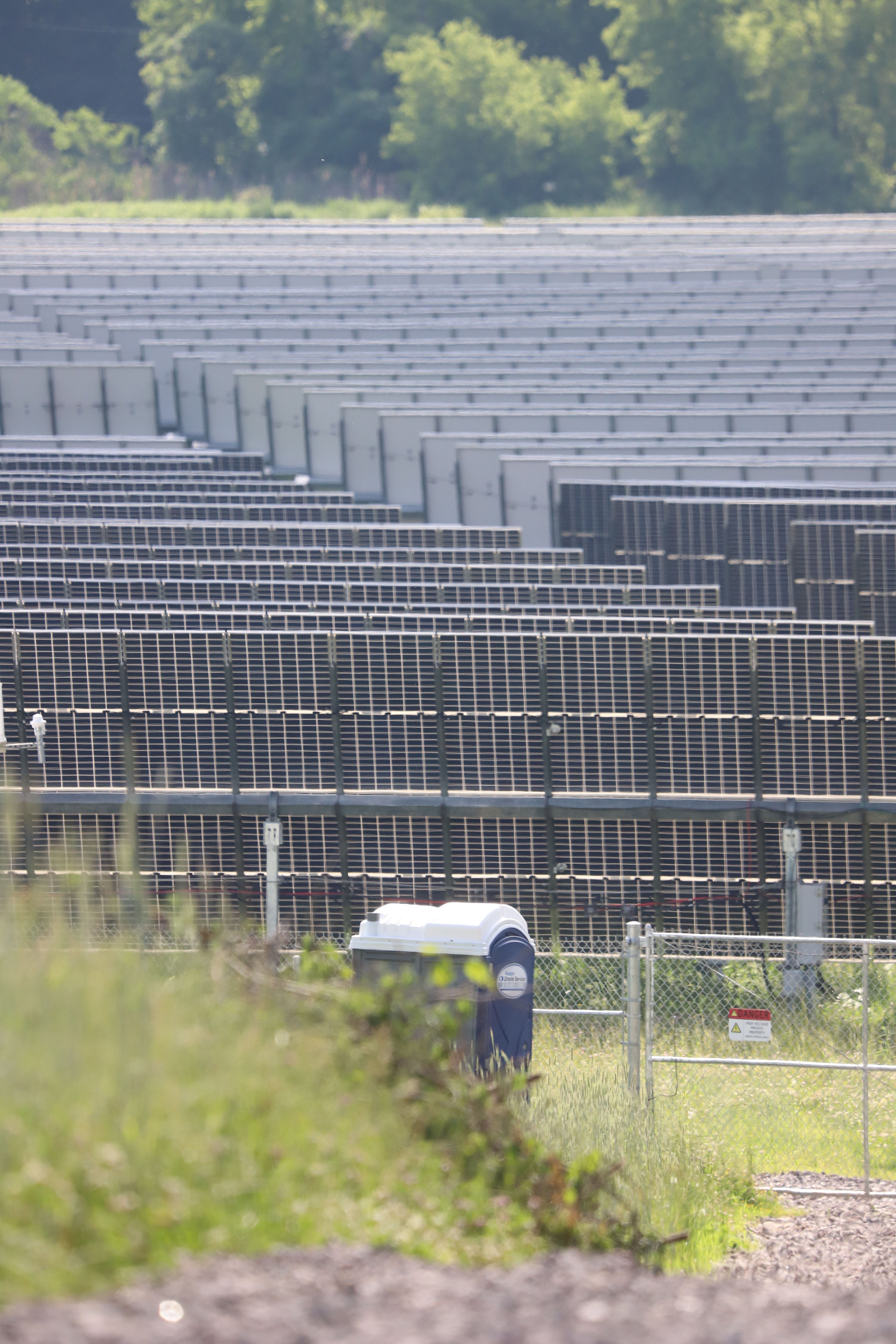
Last week, the unthinkable happened: a notice was filed on the Department of Public Service docket for Flat Creek Solar announcing the final siting permit had been relinquished by the developer. I covered why the permit was relinquished here.
The latest owner of the permit, Pattern Energy, acquired Cordelio Power as of April 1, 2026. Pattern Energy, through its law firm, Young/Sommer, elected to relinquish the final siting permit that the project had been awarded by the Office of Renewable Energy Siting (ORES).
If Flat Creek Solar had been built, where would the more than $500 million committed to the project through the New York State Energy Research and Development Authority (NYSERDA) have gone? And what exactly is Pattern Energy, where does it originate, and who ultimately stands to benefit from its investments?
Are ORES solar complexes Trojan horses for foreign pension plans?
According to Pattern Energy’s LinkedIn profile, “Pattern Energy is a major private renewable energy company that develops, constructs, owns, and operates wind, solar, transmission, and energy storage projects.”
I did a little digging.
In 2020, CPP Investments, the Canada Pension Plan Investment Board, acquired all outstanding shares of Pattern Energy in a transaction valuing Pattern at roughly US$6.1 billion, including net debt. Pattern Energy became a private company.
According to CPP’s website, CPP is the professional investment manager for the Canada Pension Plan Fund, investing on behalf of more than 22 million Canadian contributors and beneficiaries. Its statutory mandate is to “maximize long-term investment returns without undue risk,” and it operates at arm’s length from Canadian governments.
I found that interesting considering Fort Edward Solar, the 100 MW ORES solar complex sited for one of the last grasslands of its kind in the Northeast, has also been traded among Canadian corporations, from Boralex to Brookfield Asset Management.
As of June 2025, Pattern announced that a consortium had acquired Riverstone Holdings’ equity interest in Pattern.
According to Pattern’s website, that consortium was headed by “APG Asset Management, investing on behalf of ABP, the largest Dutch pension fund, together with Australian Retirement Trust (ART).”
They became Pattern owners alongside CPP Investments and Pattern management.
That means Pattern is currently backed by at least three major retirement/pension pools:
CPP Investments: Manages the Canada Pension Plan Fund for more than 22 million Canadian contributors and beneficiaries.
APG / ABP: APG invested in Pattern on behalf of ABP, the large Dutch pension fund.
Australian Retirement Trust: An Australian retirement/superannuation fund.
So, how much did Pattern Energy stand to earn from building out Flat Creek Solar?
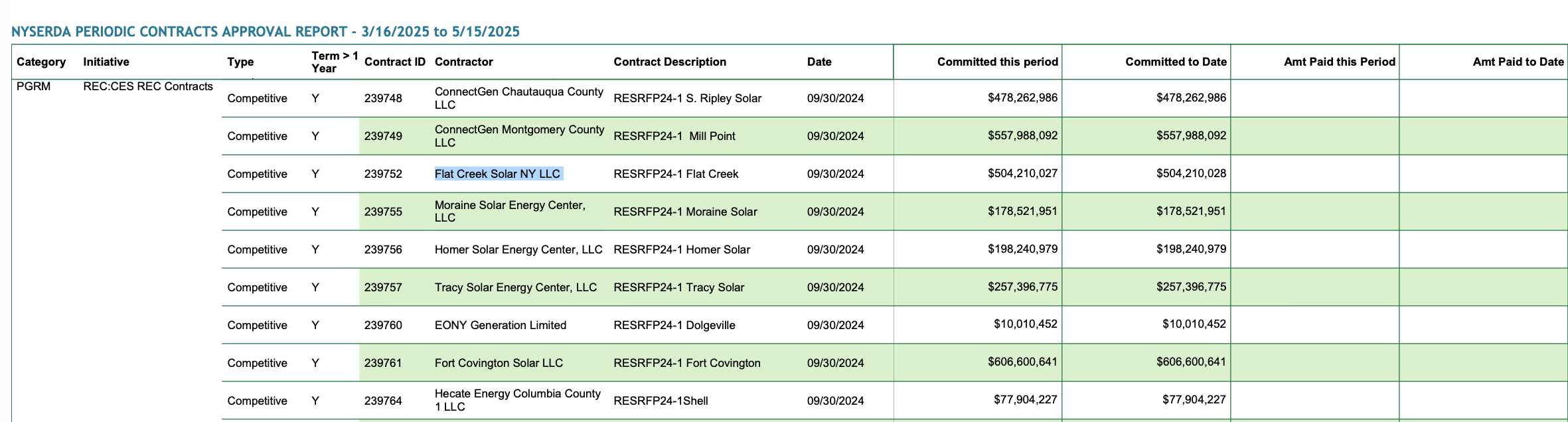
NYSERDA was prepared to pay up to $504,210,027 to the Flat Creek Solar developer over the term of its REC contract. This money would have been paid through the purchase of renewable energy certificates (RECs) once the complex was built and began generating electricity.
You might be starting to understand why ORES rubber stamps final permits for solar and wind companies 100% of the time. That’s a lot of money.
And not only is that a significant financial commitment, but a long-term contracted revenue stream from New York State can also contribute to the value and financial attractiveness of a company like Pattern Energy to its investors. Long-term contracts can reduce revenue uncertainty for renewable energy projects. CPP itself specifically described Pattern as having a portfolio of “contracted assets” when explaining its investment rationale.
Where does NYSERDA get its billions of dollars to commit to ORES solar and wind projects?
That money is coming from the ratepayers and taxpayers of New York State.
Here is how NYSERDA has over $2 billion sitting in its coffers while everyday New Yorkers can’t afford to pay their electric bills:
System Benefits Charge (SBC): This is a charge collected through utility bills and funds NYSERDA’s Clean Energy Fund programs. NYSERDA explicitly says CEF funding is collected through the SBC.
Clean Energy Standard / Tier 1 REC funding: The Public Service Commission requires load-serving entities (LSEs), utilities, and other electricity suppliers to pay NYSERDA for their share of Tier 1 RECs.
Delivery Charge: The delivery portion of an electric bill also includes state-mandated surcharges and program costs collected through utility delivery rates. Those include the SBC.
Now, to link it all together, here’s how the system works: You go to work, earn a living, pay taxes on your earnings, and pay your electric bill to keep the heat and lights on in your home. The money paid through your state taxes and electric bills trickles into NYSERDA, where that money is used to court foreign solar and wind developers to enter into a pipeline where they can guarantee ORES will issue their final permit. Once that final permit is awarded, NYSERDA commits hundreds of millions of dollars in the form of RECs to the developers over the course of the complex’s lifetime. That money is then used to back up foreign pension pools for countries like Canada, the Netherlands, and Australia.
This is one of the biggest financial scams ever peddled on the American public. Our rural towns, history, farmland, and wildlife are caught in the middle of New York State handing over our money, farmland, and future to foreign countries.
I, along with every community fighting back against ORES, would like an explanation from Governor Kathy Hochul on how this has been not only allowed, but also encouraged.
FURTHER READING
The Flat Creek Solar ORES permit has officially been relinquished: here’s why.

Covering the Office of Renewable Energy Siting (ORES) in New York State has been a depressing pursuit for the last 12 months. There is hardly ever any good news that spills out of this shadow bureaucratic agency, which was given the legal power to supersede our home rule, local zoning laws, and environmental regulations.
Purposeful understaffing: how New York State avoids answering FOIL requests

Before New York State knew I’d make it my life’s mission to expose the environmental atrocities going on through the Office of Renewable Energy Siting (ORES) for solar and wind complexes, I had some enlightening conversations over the phone with individuals who work within the Department of Public Service (DPS) and the Department of Environmental Conser…
Resource extraction at NY solar complexes: the soil “shell game” under the guise of green energy

I’ve always been a common-sense person. And I’ve always been someone who sees the big picture.
Good work! Follow the money. Too many people are betting their retirements on fairytales.
Tis always a good idea to "dig a bit deeper" on fiscal shenaningans.
I mean seriously - "follow the money", but if I was a citizen in the state of New York I would be wondering about those folks in Albany and if they have the interest of citizens in mind foremost as they ought no doubt.