


Before New York State knew I’d make it my life’s mission to expose the environmental atrocities going on through the Office of Renewable Energy Siting (ORES) for solar and wind complexes, I had some enlightening conversations over the phone with individuals who work within the Department of Public Service (DPS) and the Department of Environmental Conservation (DEC).
Now, writing this in September 2026, I have been told individuals at the DEC are not allowed to “communicate with me” on these kinds of topics. Nevertheless, I obtained the information I needed long before I was “public enemy number one” to these crooked agencies.
Naturally, I began by calling every DEC number I could find back in October 2025. Why? I had just learned about the 100 MW Fort Edward Solar project, sited for one of the last grasslands of its kind in the entire Northeast. I was also fresh off witnessing bureaucratic annihilation at the Fort Edward Solar hearing that took place at the end of September 2025.
After many calls, voicemails, and the ever-familiar game of “phone tag” that the New York State system throws callers into if they’re asking too many questions, I made contact with an individual who worked in the DEC FOIL (Freedom of Information Law) Office.
I appreciated how frank this person was with me.
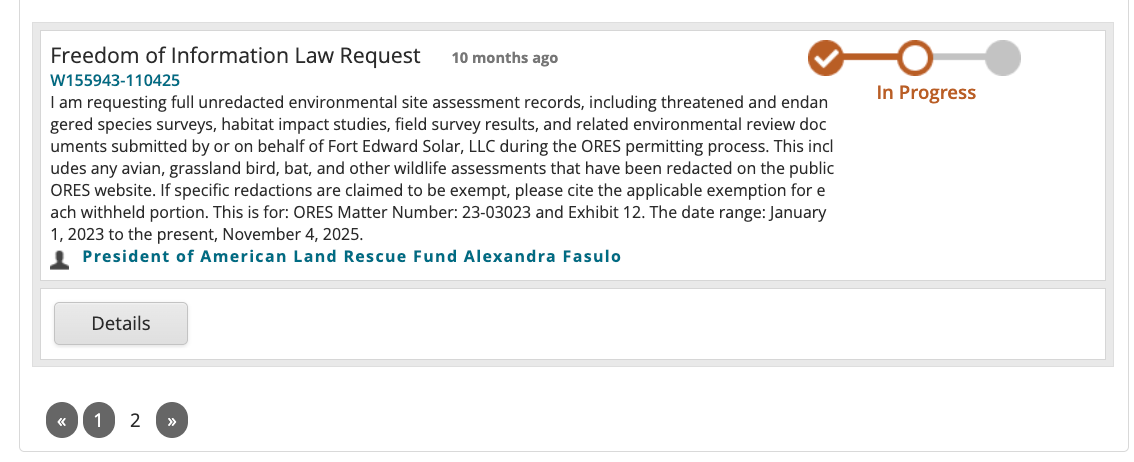
When I asked how I could obtain the unredacted environmental files that show the true ecological damage that will occur at Fort Edward Solar, this individual told me to FOIL for them. At the time, they knew the DEC would not willingly hand that information over to me, especially with another DEC employee telling me that the agency had been told to “stand down at the direction of ORES.”
And so I FOILed. That very first FOIL I submitted to the DEC can be seen at the top of this article. As you can see, 10 months later, it’s still unanswered.
Only a few weeks after I submitted the FOIL, I called the FOIL Records Office again. This would be the last time this person picked up the phone to speak to me as my reporting ramped up online.
I asked how long it was going to take to respond to this FOIL. They couldn’t give me a straight answer. I asked for a ballpark estimate or timeline. I could tell the person working there was frustrated and exhausted, sharing in my disappointment that the few individuals staffing their Records Office were going “as fast as they can.”
To put this in perspective for you, the DEC is staffed by roughly 3,000 people. Their combined annual salaries, which are funded by the taxpayers of New York State, come to $217.6 million to $241.3 million.
Knowing the agency receives thousands of FOIL requests every year, it would make logical sense that it would staff its FOIL office with a team of at least a dozen people, right? Statistically, the DEC knows these FOIL requests are coming. It’s not a surprise, and that reality is backed up by years of data.
In my last call to the DEC in November 2025, the individual tangentially hinted that the DEC, like all other New York agencies, purposefully understaffs its Records Office so it can use that efficiency gap as an excuse when it delays information that is usually needed in a timely manner.
And that’s when it hit me: the rot is so deeply embedded in these New York State agencies that, if I wanted to save the Fort Edward Grasslands, I would be up against a system that’s been stacked against the people of this state for decades.
Suing over FOIL mismanagement
Fast-forward almost one year later, and I have sued the DPS and the DEC, each over their lack of FOIL responses.
I have noticed a three-part approach to “tough FOILs” that would require these agencies to disclose information they don’t want shared with the public:
For the most damning FOIL requests of all, they don’t answer them. My one FOIL above is going on 11 months without a response.
For “partially damning” FOIL requests, they delay answering them for about 4–5 months and produce a partial response that conceals the meat of the request. We have sued over this twice.
For “simple FOILs” that don’t expose the information cover-up going on at these agencies, they answer them, for the most part, truthfully within 1–4 months.
As the months wore on and I struggled to understand why these agencies would flirt with potential litigation so obviously, the reality set in: they are willing to be sued, pay attorney fees, and go through the litigation process if it means they can keep critical information, like endangered species deaths and eagle carcass numbers under wind turbines, hidden.
Then, as I learned about the amount of money being paid out to foreign renewable developers—one example being Flat Creek Solar receiving a $504,210,027 commitment from NYSERDA over the lifetime of the complex—I went even further down the rabbit hole of understanding the regulatory capture that has New York agencies in a chokehold.
The renewable corporations and their law firms own our state government.
For that regulatory capture to continue in real time, transparency must be shut down at all costs. Even if that means being relentlessly sued by the citizens, nonprofits, towns, and counties of the state.
Missing the window
If FOILs are delayed for one year at a time, that prevents the opposition from being able to sue over the information or share the findings with the public. Without that information, the public is not able to form a unified understanding of the scope of the problem. Attorneys are not able to sue over the true extent of, in this case, the environmental damage or escalate the problem to the federal government.
Everyone has to “guess.”
And lastly, the average New Yorker does not have the time, nor the money, to hire an attorney and sue a New York State agency. This takes hundreds of hours and has only been feasible thanks to the generosity of everyday people supporting American Land Rescue Fund. It’s also thanks to the brilliant attorney I connected with, who cares more about saving the environment than she does about the money attached to it.
I know I say this a lot, but it’s important to sit with this today: We shouldn’t have to form nonprofits, raise money, find attorneys, and file lawsuits to get the state to follow its own laws. Albany, New York, is being held hostage by an oligarchy that’s funded by foreign companies and influence.
The most blatant proof of that is the breakdown of the FOIL process in real time.
With Election Day approaching two months from today, I can tell you firsthand that things are about to heat up over the renewable energy debate.
Lots to come… stay tuned.
FURTHER READING
Resource extraction at NY solar complexes: the soil “shell game” under the guise of green energy

I’ve always been a common-sense person. And I’ve always been someone who sees the big picture.
Your wish is our command: New York's PSC grants Boralex's request to transfer 13,100 acres of solar leases without further review

“Regulatory capture is a government failure where a public regulatory agency prioritizes the commercial or special interests of an industry over public welfare. It is driven by heavy lobbying, the "revolving door" of personnel between agencies and private firms, and information asymmetry.”
Living in a solar industrial wasteland: one woman's account from Byron, New York

Our brains often “tune out” background noise and habitual sights and sounds that we have come to accept as safe. Instead, our minds scan for disruptions, danger, and exceptions in an effort to stay alive for another day. It’s how your ancestors before you survived long enough to pass on their genes.
The Politicritters and bureaucratic denizens who populated Albany are not "held hostage". Its a deliberate act on their part.
The Politicritters ultimately oversee Agency staff. The Politicritters are beholden to campaign cash provided by special interests or they lose their cushy positions. The Agency denizens can lose their jobs if they displeased the Politicritters. The paycheck is a lifeline.
We are just simply pawns and serfs to please them. But we can vote them out. We must vote them out.
I'm very familiar having worked at NJDEP and EPA for 22 years with routine stone walling and poor treatment and disrespect of citizens by senior managers at environmental agencies. The agency managers [not so much staff] despise the public because they side with the polluters. The public generally is the enemy. The public makes things awkward when it reviews and comments on agency actions and seems to intrude on otherwise unfettered agency and state power and discretion to cut deals, shield polluters and curry favor and job prospects with polluting corporations [the large ones not the small businesses]. Records requests are a small part of an agency workload. It wouldnt be hard to respond quickly and fully to a request. It doesnt require alot of staffing or money to meet the statutory standard. The public is simply entitled to know, and its doesnt delay or disrupt agency workloads. Agency refusal stems from long term managers backed by the governors office in most cases which are not friendly to the public, so refusal to respond is purely a matter of petty political hostility to the public.